
For Chiefs of Schools · Networks · Family-serving institutions
The same conflict keeps arriving at your desk from three different campuses.
It is not three problems.
[is it one expectation nobody in the network has said out loud?]
We help Chiefs of Schools find the unspoken expectations underneath recurring conflict, then build the working relationships that keep it from coming back.
8years on site
A four-site charter organization, four distinct cultural communities, and conflict-resiliency programming now used by educators across Georgia.

What isn't being said
The presenting problem is usually accurate and incomplete. Hover or focus a line to see what turned out to be going on.
- “She's being difficult about the IEP meeting.”
- She has been in a room like this before and it did not go well.
- “The team isn't bought in.”
- They were told on Thursday about a decision made in June.
- “A parent stops coming to conferences.”
- What did the last one cost them?
Interlude · palatable tension
Everyone agreed. Nobody consented.
[what was the agreement protecting?]
From a board retreat debrief, winter
How the work goes
−1
A reading.
Two days on site, interviews with staff, leadership, and families, and a written account of what is actually driving the pattern.
3-4 weeks · written reading + leadership session
−2
Two days with your people.
Practice, using the real situations your team is carrying rather than a curriculum delivered at them.
Two days on site · protocol card your staff keep
−3
Reinforcement.
The term gets busy, and most of this reverts if nobody comes back to check.
Across a term · 30- and 90-day check-ins
Every behavior in a school is a message sent in a language the building may not speak. From a facilitation debrief, spring.
Named testimony
“I used to think of culture mostly in terms of race or traditions, but I now see it also includes how we live, manage our finances, where we grow up, how we face challenges, and the perspectives we bring to everyday life.”
Instructional Services Coordinator, Child Welfare Training Collaborative, Georgia State University.
“He connected with both parents and students in a rare way, especially ones who were struggling.”
Charter School Site Administrator. Worked with Andre for five years.
“Together, we co-created and successfully delivered conflict resiliency programming that has since been utilized by educators statewide.”
Director of Impact, The Mediation Center of the Coastal Empire.
“We already did DEI training.”
Then your staff have been told what to think about difference. This is a different job: what to do on Tuesday when two of them disagree about a family.
“Our campuses are too different for one approach.”
That difference is part of the work. Campuses develop different assumptions about communication, leadership, families, and what normal looks like. The goal is not to erase them. It is to make them visible enough to work with on purpose.
“Our principals will resist.”
They should. Someone is arriving to look at their building. We brief every principal individually before anyone else is involved, and they are not the subject of the study.
“How do we measure this?”
Not with a control group. We measure participant capability before and after, escalations reaching central office, and whether the artefacts are still in use at ninety days. We will tell you what we cannot claim.
Slow down · seeing the full picture
Nothing here needs a decision today.
Read the conflict underneath. Then decide.
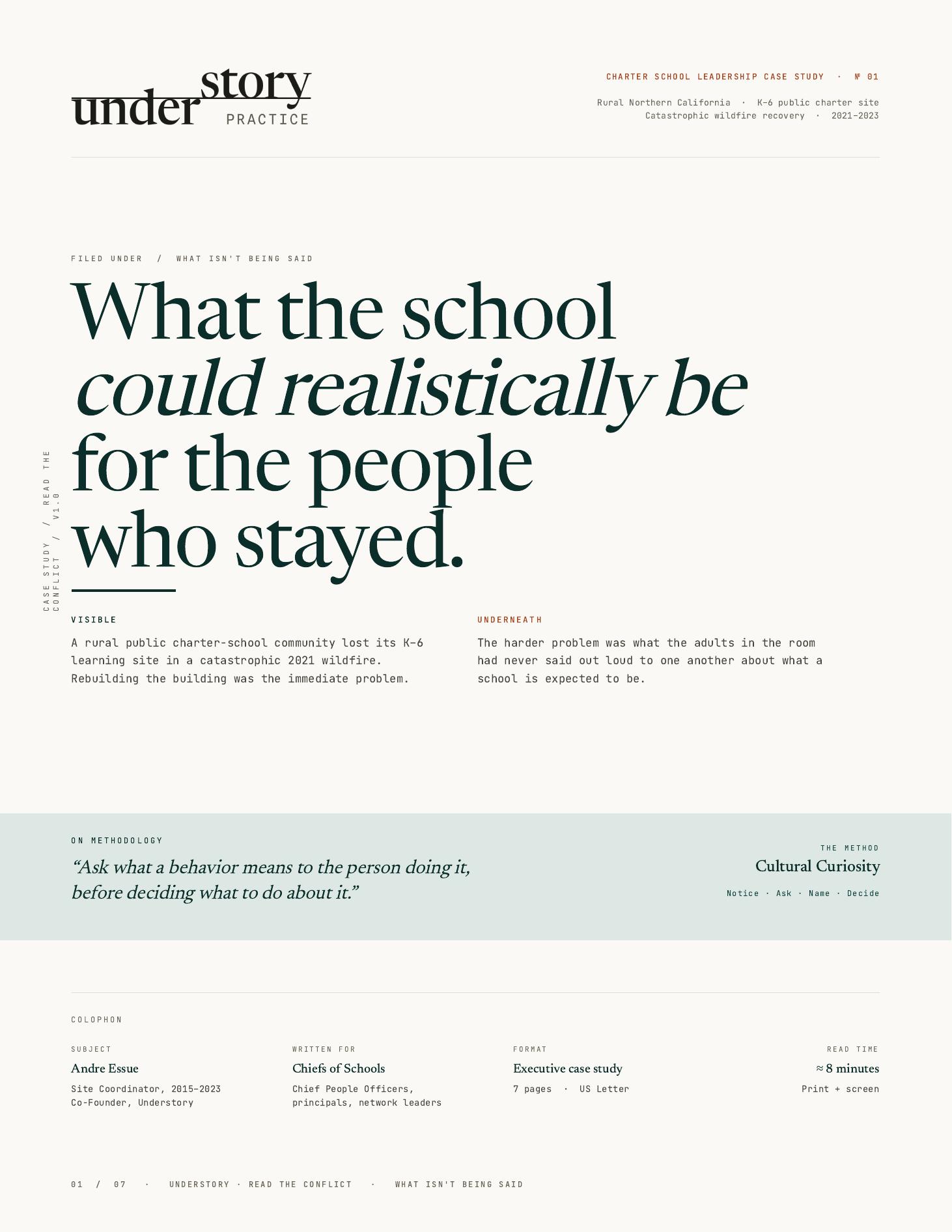
Case study
The wildfire was exceptional. The pattern underneath it was not.
An eight-minute case study for charter-network leaders on recurring conflict, family trust, and what schools carry when expectations have never been stated aloud.
Seven pages. Includes a 10-minute field diagnostic.
Where Chiefs of Schools usually go next
- What a Chiefs of Schools engagement includes →
The reading, the two days, and reinforcement across the term.
- Cultural tension consulting for charter network Chiefs of Schools →
How a multi-campus read is scoped, plus the network pattern check.
- The method Chiefs of Schools use to read a building →
Notice, ask, name, decide, and the private path for Chiefs of Schools.
- FAQ before booking →
Scope, timelines, deliverables, and how fees are quoted.
- Why Chiefs of Schools call Andre Essue →
Eight years inside a four-site charter organization.
- Read the Conflict: the case study for Chiefs of Schools →
Seven pages, plus a 10-minute Cultural Tension Read.

If you recognized your building in any of this, that is enough to start a conversation.
Thirty minutes, spent on your building rather than on the offer. Andre takes the call himself.